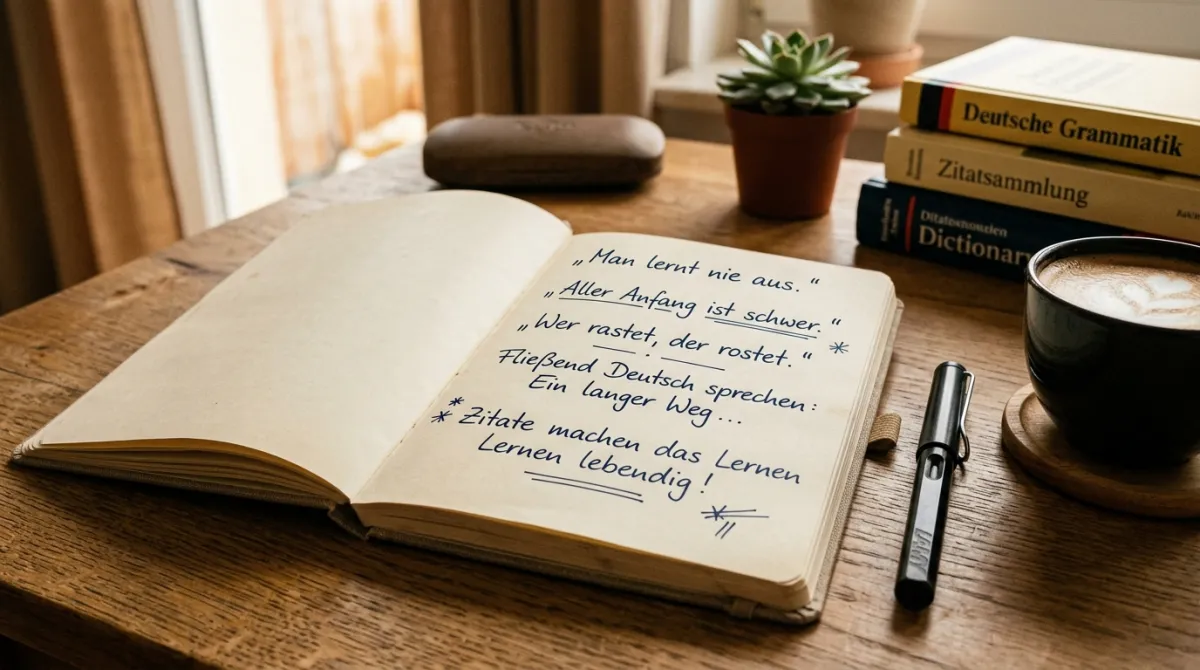
Quotes are a strange teaching tool. They're short. They sound clever. They get repeated until everyone thinks they understand them. Used well, they're one of the densest ways to absorb a language: real grammar, real vocabulary, real cultural reference, all in a single line you'll actually remember. Used badly, they're motivational wallpaper.
Why quotes work for language learners
A flashcard gives you a word. A sentence gives you a word in syntax. A quote gives you a word in syntax that you've already heard, that fits in your mouth comfortably because you've encountered it before. The structure attaches to a memory hook that isn't grammar drudgery. Your brain holds onto it.
The catch: you need real quotes by real authors, not anonymous "wisdom" plastered on Pinterest. Real quotes have author and source. They're verifiable. They're also free of copyright if the author has been dead long enough - in most jurisdictions including Germany (UrhG §64), 70 years past the author's death.
Everything below is from authors who died before 1956. Use them, quote them, share them. Translation conventions: literal first (showing the German word order), then a natural English version when the literal one strays too far.
Goethe
Johann Wolfgang von Goethe (1749-1832). Poet, polymath, civil servant, the towering figure of German letters. If you only ever quote one German, this is the one.
Wer fremde Sprachen nicht kennt, weiß nichts von seiner eigenen.
Literal: Who foreign languages not knows, knows nothing of his own. Natural: Whoever doesn't know foreign languages knows nothing of their own. From Maximen und Reflexionen.
Grammar this teaches: the relative pronoun wer as a subject without an antecedent (a German construction that English speakers have to translate around). Note the verb at the end of the side clause (kennt) and the second verb in the main clause (weiß) at position II.
Es ist nichts schrecklicher als eine tätige Unwissenheit.
Literal: It is nothing more terrible than an active ignorance. Goethe's diagnosis of confident stupidity, also from Maximen und Reflexionen.
Grammar: the comparative schrecklicher als (more terrible than). Note tätig as an adjective ending in -ig taking -e for feminine accusative.
Erfolg hat drei Buchstaben: TUN.
Literal: Success has three letters: DO. (TUN being the German verb to do, which, conveniently, has three letters.)
Grammar: nominative subject (Erfolg), straightforward present-tense verb. The whole thing fits on a Post-it. Drill the verb tun while you're at it - irregular, common, useful.
Schiller
Friedrich Schiller (1759-1805). Poet, playwright, historian. Goethe's friend and rival. The other half of the Weimar Classicist pillar.
Wer nichts wagt, der gewinnt nichts.
Literal: Who nothing risks, that-one wins nothing. The German "nothing ventured, nothing gained" - except notice the structure: a wer clause followed by der as the demonstrative pronoun referring back to it.
Grammar this teaches: paired wer ... der construction. Common in proverbs and old-fashioned writing. Recognise it; you'll see it everywhere.
Dem Mutigen gehört die Welt.
Literal: To the brave belongs the world. The brave inherit the earth, German edition.
Grammar: dative case in action. gehören takes a dative object (the brave one - dem Mutigen), with the subject (die Welt) in the nominative. Word order is flexible because the cases mark roles, not positions.
Friedrich Nietzsche
Nietzsche (1844-1900). Philologist turned philosopher, syphilis casualty, source of more misquoted lines than any other German thinker. The actual ones are sharper than the misattributed ones.
Was mich nicht umbringt, macht mich stärker.
Literal: What me not kills, makes me stronger. From Götzen-Dämmerung (1888).
Grammar: the relative pronoun was referring to an indefinite something. Two parallel clauses with the implicit subject in both being das (which). Note the comma before the main verb macht - mandatory in German.
Ohne Musik wäre das Leben ein Irrtum.
Literal: Without music would the life an error be. Natural: Without music, life would be a mistake. Also from Götzen-Dämmerung.
Grammar: Konjunktiv II (wäre instead of ist) for hypothetical conditions. Ohne takes the accusative. Useful counterfactual structure - learn this and you can talk about anything that didn't happen.
Heinrich Heine
Heine (1797-1856). Poet, journalist, exile. Wrote in German from Paris, banned in his homeland for most of his career. Quoted often without attribution because his lines are so quotable.
Dort, wo man Bücher verbrennt, verbrennt man am Ende auch Menschen.
Literal: There, where one books burns, burns one in the end also people. Natural: Where they burn books, in the end they burn people too. From the play Almansor (1823) - a line that became unspeakably grim a century later when the Nazis literally burned books, and worse.
Grammar: man as the impersonal subject (one/they). Dort, wo as a fixed structure for "the place where". Two main clauses connected by a relative location.
Immanuel Kant
Kant (1724-1804). The philosopher who made Königsberg famous and German philosophy unreadable. The categorical imperative is his most-quoted idea.
Handle so, dass die Maxime deines Willens jederzeit zugleich als Prinzip einer allgemeinen Gesetzgebung gelten könne.
Literal: Act so that the maxim of your will at-any-time at-the-same-time as principle of a general legislation valid could be. Natural: Act in such a way that the maxim of your will could at the same time always serve as the principle of a universal legislation.
Grammar: this is a sentence to read three times. Handle so, dass opens an imperative-then-consequence structure. The verb könne at the end is Konjunktiv I (third person, used for indirect speech and aspiration). Useful exercise: try diagramming it.
Arthur Schopenhauer
Schopenhauer (1788-1860). Pessimist, dog-lover, Hegel-hater. Influenced everyone from Wagner to Wittgenstein.
Talent trifft ein Ziel, das niemand anderes treffen kann; Genie trifft ein Ziel, das niemand sehen kann.
Literal: Talent hits a target, that nobody other hit can; Genius hits a target, that nobody see can. Natural: Talent hits a target no one else can hit; genius hits a target no one else can see.
Grammar: parallel structure with two relative clauses (das niemand ... kann) using the modal kann at the end. Notice the verb-final pattern in both side clauses - a textbook example.
Gotthold Ephraim Lessing
Lessing (1729-1781). Enlightenment dramatist and critic, ahead of his time on religious tolerance.
Der langsamste, der sein Ziel nicht aus den Augen verliert, geht noch immer geschwinder, als jener, der ohne Ziel umherirrt.
Literal: The slowest, who his target not from the eyes loses, goes still always faster, than that-one, who without target around-strays. Natural: The slowest person, who never loses sight of their goal, still moves faster than the one who wanders aimlessly.
Grammar: nominalised superlative (der langsamste = the slowest one), als for comparison, the prefix verb umherirren (around + to wander) showing how German builds compound verbs from prepositional prefixes.
Brüder Grimm
Jacob (1785-1863) and Wilhelm (1786-1859). Linguists, lexicographers, fairy-tale collectors. Their Deutsches Wörterbuch ran to 32 volumes and took 123 years to finish.
Es war einmal ein Mann, der hatte drei Söhne...
Literal: It was once a man, who had three sons. Natural: Once upon a time there was a man who had three sons. The opening of countless Grimm tales.
Grammar: Es war einmal is the German fairy-tale opener you have to know. The relative clause der hatte uses simple past (Präteritum) - the standard tense for narrative. Notice how German switches into Präteritum for storytelling, even though spoken German prefers Perfekt for past events in conversation.
Ludwig Wittgenstein
Wittgenstein (1889-1951). Austrian-British philosopher, engineer, gardener, school teacher. The Tractatus reads like a series of cryptic German aphorisms because that's what it is.
Die Grenzen meiner Sprache bedeuten die Grenzen meiner Welt.
Literal: The limits of my language mean the limits of my world. From the Tractatus Logico-Philosophicus, proposition 5.6.
Grammar: two genitive constructions (meiner Sprache, meiner Welt). The verb bedeuten takes a direct object in the accusative. Both nouns here are feminine, so the genitive looks identical: meiner.
How to actually use these
Pick three. Memorise one per week. After a month you have a small repertoire of real German that you can deploy without thinking, plus the grammar that comes attached.
Concrete drill: write each chosen quote out by hand. Then write the literal English under each German word, then the natural English on the next line. Then close the book and try to reproduce the German from the natural English. Repeat for three days. The structure plus the meaning together make the encoding more durable than either alone.
For more grammar context, my Superhero Technique post covers article gender, and the irregular verbs post covers verb conjugation - both of which appear in nearly every quote above.
Frequently Asked Questions
Are these quotes copyright-free?
Yes. All twelve authors above died before 1956. Under §64 of the German UrhG (and equivalent law in most jurisdictions), works fall into the public domain 70 years after the author's death. Use them freely.
What about modern German quotes from authors like Hesse or Brecht?
Brecht (died 1956) and Hesse (died 1962) are still under copyright in Germany until 2027 and 2033 respectively. Quote a single line for commentary or criticism (covered by §51 UrhG, the German equivalent of fair use), but don't republish their work in bulk.
What's the most-quoted German line?
Probably Nietzsche's "Was mich nicht umbringt, macht mich stärker", helped along by Kanye West and others. The runner-up is Goethe's "Mehr Licht!" (more light), reportedly his last words - though that one is disputed.
How long does it take to memorise a German quote?
Three days of light spaced repetition for a one-sentence quote. Less if you have the grammar already; more if every other word is unfamiliar.