Pick shows that match where you actually are. If you are unsure, check the German language levels first, then choose accordingly.
You wouldn't believe how often I see self-organized students on Reddit asking how they can learn German with help of TV series. But that's often the wrong question. They should rather ask whether it's worth the effort and if you know me a little bit already, you will predict my response to that question.
The Reality Check
The good news: Movies could provide you with real-world conversations and additional visual context that helps bridge gaps in your German. They are interesting and you might expose yourself to German longer than you would forcing your way through that textbook you saved from your last classroom experience. Not too bad. But…
If you are a beginner - meaning you haven't conquered B1 yet - watching movies requires a lot of work. I doubt watching is the best approach. Of course it doesn't harm to check in and see how much you get already when watching Cleo or an episode of Deutschland 83, but when it comes to learning German efficiently, movies or series are not the way to go in my not-so-humble professional opinion. Here's a reliable method to learn German from a series.
Here's what's needed to actually benefit from learning German from a series or movie:
You Need to Understand What You Hear
If you don't prepare the audio, you are not going to get much from it and how can you prepare the audio of a movie? You'd have to download the subtitles. I can't recommend them to everyone.
Language Reactor is a lot easier to use and free to use for basic use but if you really want to benefit from their fine work, you will need their pro version.
Take a look at any of these tools. There are plenty of alternatives, like my courses, which offer more guidance and structure.
How to Do It Right (If You Insist)
Prepare BEFORE You Watch
The first thing you could do is to watch the episode with English subtitles so that you get an idea of what it is about.
If you really want to learn from your series, you need to prepare the text. Look up all words - use readlang.com for that - and practice them a bit with your flashcards tool. A 20-minute episode of Big Bang Theory exposes you to 600 to 900 unique words. You should be at least A1, ideally A2, to understand most of it.
Sitcoms are generally easier to follow over time as they have repetitive elements and characters might re-use certain words and phrases which you will benefit from.
Watch in Increments
Rather work through a five-minute segment of an episode than trying to get the full series.
Then, when you are done, watch the full episode again but this time without subtitles.
Watch It Repeatedly
Repetition is the mother of all learning. Common words and phrases repeat in any series. Watching the same episode multiple times helps.
Now, when you watch an episode a 2nd or 3rd time, you can pause the video whenever there's a phrase or situation that you didn't get fully and look up the missing words and take note of them. Readlang and Language Reactor will help you with that.
Take Advantage of Spaced Repetition (SRS)
When you are done with one episode, continue with the next one whenever you feel ready. After a week, rewatch your prepared episode to assess your progress.
The Shows
Let's jump in.
Extra auf Deutsch
This show was made specifically for language learners. It's a sitcom with simple dialogue, plenty of repetition, and exaggerated acting—which may sound terrible, but actually works really well when you're just starting out. It's like "Friends" for German learners. Each episode focuses on a specific language theme like shopping, love, or job hunting. Great for vocabulary and listening. And don't worry if this is too trashy for you. Luckily there are many more series to work with.
Verbotene Liebe (Forbidden Love)
A classic soap opera. Glamour, betrayal, complicated family trees—you know the drill. It's a bit over the top (on purpose), but the slower pace and emotional acting make it easier to follow. Bonus: tons of everyday language in romantic and dramatic contexts. It aired from 1995 to 2015, so you need to enjoy soap operas. And ideally you are a fan of the past because in the last 10 years things have changed quite a bit and this series might feel like looking at a time capsule
Türkisch für Anfänger (Turkish for Beginners)
A German-Turkish family blends into one chaotic household. Funny, warm, and surprisingly deep. The characters argue, love, and grow together—and you get to learn how Germans (and German-Turks) speak in everyday life. Highly recommended.
Stromberg
If you've seen "The Office," this is the German version. Less heart, more biting satire. Stromberg is the world's worst boss, and every episode is a reminder of how not to behave. Great for listening to fast, informal office speech—if you can handle the cringe or Fremdschämen (feeling ashamed for others) as we say in German.
Tatort
Germany's longest-running crime series. Every episode takes place in a different city, with a different investigative team, so it never gets stale. It's crime drama with social commentary, reflecting regional speech and current events. A staple of Sunday evening TV in Germany.
But trash doesn't mean you can't learn German. Just lower your standards by a lot and you'll take some conversational German from it.
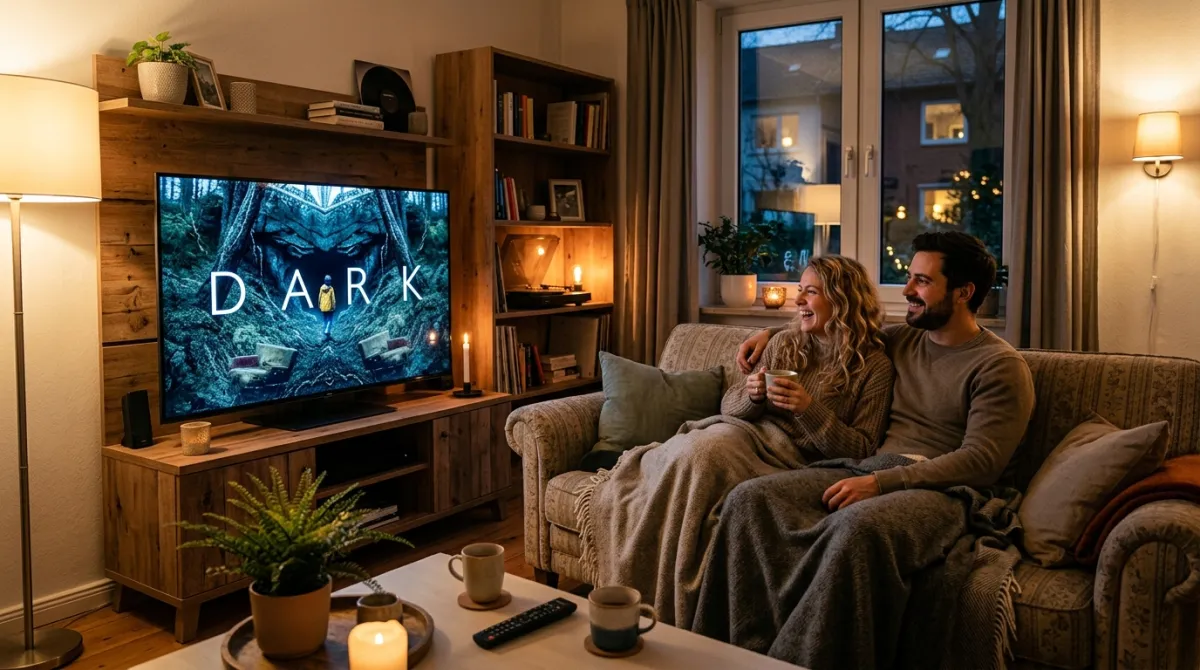
Dark
If you like time travel and can handle complex relationships, Dark is great. Subtitles highly recommended, at least for the first few episodes. You'll learn advanced vocabulary and get pulled into a plot that respects your intelligence.
Dogs of Berlin
Two mismatched Berlin cops investigate the murder of a Turkish-German football star. It's dark, intense, and touches on real issues—racism, corruption, organized crime. Not for kids. Expect rough language and authentic street German.
Das Boot
Set in WWII, this drama follows a German U-boat crew and a resistance sympathizer on land. It focuses on people and pressure, not just war. Language-wise, it's serious and formal, often military or political. Good for advanced learners wanting to go beyond casual conversation.
Der Tatortreiniger (Crime Scene Cleaner)
Schotty cleans up crime scenes and has strange little philosophical chats with whoever's around. That's the entire concept—and it's brilliant. Each episode is self-contained and full of dry humor. You'll get exposed to slang, regional dialects, and odd situations.
Charité
A historical hospital drama set in Berlin's famous Charité hospital. The show spans different eras—Imperial Germany, Nazi rule, and East Germany—mixing personal stories with medical breakthroughs. It's a slow burn but rich in vocabulary around science, ethics, and power. Ideal if you like serious storytelling and want to train your ear for more formal German.
Weissensee
Weissensee is a period drama about two families living two lives with two destinies in a single divided Germany. Set in the 80s, Weissensee offers insight into life in divided Berlin.
The show follows significant historical events like the fall of the Berlin wall and the introduction of the German D-Mark (also called Deutschmark) and how these events unfolded and the effect they had on the lives of the people living in the divided city.
Deutschland 83 / 86 / 89
A Cold War spy thriller with a fast pace and a killer soundtrack. It follows a young East German soldier turned reluctant spy in West Germany. The series blends political drama with cultural detail, switching between East and West slang. Great for intermediate to advanced learners who want a gripping story and real historical context.
Cleo
A wild mix of revenge, dark comedy, and 90s Berlin weirdness. Cleo is a former Stasi assassin out for payback after being betrayed by her own people. The tone jumps from bloody to bizarre in seconds—but never boring. Not textbook German, but definitely unforgettable.
Where to Watch German TV Shows
- Netflix (most shows above are available there)
- Amazon Prime Video
- YouTube (especially for beginner-friendly content like Extra auf Deutsch)
- ARD Mediathek / ZDF Mediathek (free German platforms—use a VPN if outside Germany)
Frequently Asked Questions
What's the best German show for beginners?
If you follow my advice, start with any show you like. There's no need to torture your intellect with the likes of Tatort or Extra. Fast paced action might be a bit more difficult to get a hold of but again, you work strategically, you'll even manage that realiably.
Can I really learn German just by watching TV?
TV can in theory help a lot with listening and passive vocabulary IF you put in the hard work necessary to unlock it. But no, it won't replace speaking, writing, or grammar practice. It's one piece of the puzzle—not the whole picture.
Should I use English or German subtitles?
Use English subtitles on your first watch through so you know what's coming. Aim to watch a series without subtitles to practice listening, not reading. For reading you better read a book.
Is "Tatort" worth watching?
Not if you ask me, but as a reality check in regards to how degenerate the Germans that still watch this must be, definitely. It's a hard realization though but hasn't TV always been about numbing the mind? At least you can benefit from it due to its pretty basic dialogues and flat plots. That's not to be discarded just because your favorite German teacher can't stand a minute of that show.
What's a good mix of watching and studying?
One idea: watch 5 minutes at a time and work through them. Then go for the next 5 minutes until you reach the end. A show with shorter episodes of about 20-30 minutes is best to start with. First watch it with English subtitles to get the story straight, then work through the downloaded German subtitles and then watch it with no subtitles. Use a second and third round to note down difficult and/or useful expressions.
Final Thoughts
Learning German through TV is less entertaining than you would hope for. It's hard work, at least if you want to do it right.
On the plus side, you'll be hearing real accents, absorbing culture - or at least what those writers think their viewers favor, and learning how Germans actually speak (not just how textbooks think they do).
Start small. Do your homework and pick a show that interests you most. No one will blame you for working with a soap opera. Also, don't try to understand everything at all cost. There will always be things that will stay incomprehensible for a long time. Take note of these things and move on.
And if all you do is watch a German show with English or even German subtitles, I wouldn't count that towards my study time if I were you. It's not wrong to do that, it's just not the kind of German learning you might hope it would be.