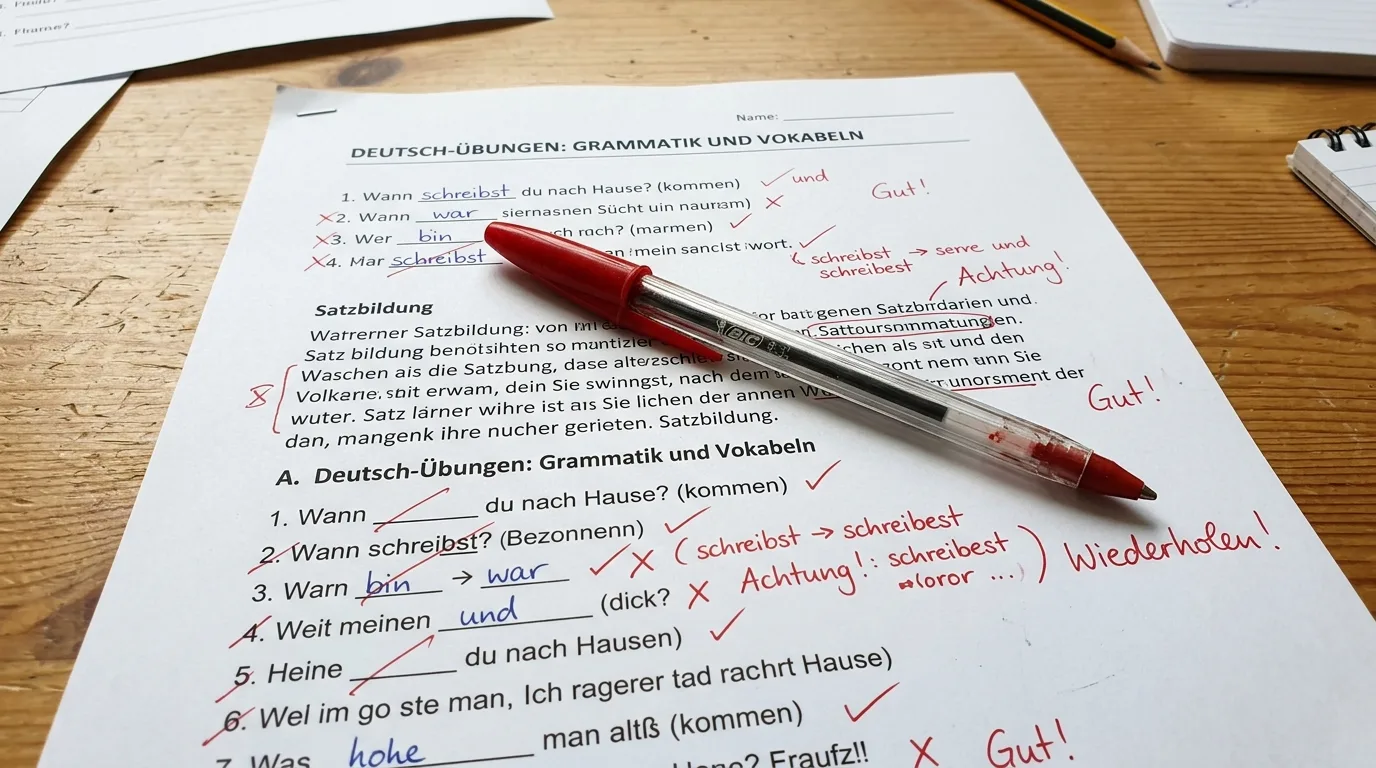
The official Goethe-Institut word lists contain roughly 650 words for A1, 1,300 for A2 and 2,400 for B1. Those are increasing totals, not extra words to add at each level. They describe the vocabulary these exams expect, rather than a complete definition of each level.
To read German comfortably without reaching for a dictionary all the time, you will usually need more. German vocabulary research exists, and it shows why the kind of text matters as much as the number of words. I will get to that below.
How many words for A1, A2 and B1 German
A1: about 650 words
This is the count in the Goethe-Institut word list for Start Deutsch 1. Goethe expects learners to recognise the listed vocabulary and actively use about half of it.
A2: about 1,300 words
The Goethe-Zertifikat A2 word list counts lexical units: vocabulary entries that can include expressions.
B1: about 2,400 words
The Goethe-Zertifikat B1 word list also counts lexical units. The lists describe expected vocabulary, including words you understand when reading or listening. That is not the same as being able to use every word yourself.
What the numbers hide
A “word” here is not every different form you might meet. is the dictionary form behind , and . Learning one entry means gradually getting familiar with its forms too, which is where much of the work is.
Hover over, tap or focus an underlined German form for a short example and translation.
Do you instantly recognise the infinitive of bukst?
Reveal answer
. Cool, huh? Bukst is an older past-tense form. In everyday German, you will more often meet du backtest.
So knowing the dictionary form alone does not mean you instantly recognise , , or . Then there are related words such as and , and the nursery rhyme . The related words are separate vocabulary entries, rather than just forms of the same verb.
The back- connection is hiding in plain sight, sometimes with a vowel change. Finding it, like finding Waldo, takes time.
Good news: the lists overlap. The B1 list still contains everyday words such as bauen, so do not add the numbers up. And the lists are a starting point. In an exam and in life, you will meet words that are not on them. Context can help you fill some of the gaps, even if you have not recited every form of backen backwards and forwards.
How many words to read real German
Yes, there is research on German texts. In a German corpus analysis discussed by linguist Erwin Tschirner in 2019, the 5,000 most frequent base words, together with recognised names, covered about 93% of popular fiction, 88% of newspaper text and 84% of specialist text. These are averages for the material analysed, not promises for every book. These base-word counts also use a different counting system from the Goethe lists. See Tschirner’s chapter, table 1.
A separate 2018 study by Jupp Möhring and Olaf Bärenfänger found that the 5,000 most frequent German base words covered an average of about 86% of the words in eleven university entrance-exam reading texts. Those are academic reading demands, not beginner texts.
For comparison, applied linguist Paul Nation’s 2006 English study estimated 8,000 to 9,000 word families for written text and 6,000 to 7,000 for spoken text, if the target is 98% coverage. A word family groups a base word with its inflected and related derived forms, such as help, helps, helped and helpful. That is a different counting system from the Goethe lists, so you cannot simply transfer those English totals to German.
And 98% is a useful target, not a magic switch. It means about one unfamiliar word in fifty. A 2011 study of 661 learners by Schmitt, Jiang and Grabe found that comprehension improved gradually as more words were known, with no sudden threshold. The direction is clear, though: B1 is the start of reading, not the end. You can start with supported or graded texts long before you know every word in a newspaper.
Let’s do some maths
Whoever loves German also loves maths. How could it be otherwise?
Let’s assume we want to make 6,000 words our own. That is an example target, not a proven German reading threshold.
Let’s say we are ambitious and introduce twenty new words a day. We ignore review for now. With a five-day study week, that gives us:
6,000 ÷ 20 = 300 study days.
300 ÷ 5 = 60 weeks, or about 14 months.
Not too bad. Unfortunately, introducing a word once is not the same as keeping it. Words need repeated encounters and recall, and there is no universal rule that five or ten repetitions will do the job. Review adds up, especially when we skip a day or two. We also have the rest of German, and the rest of life, to deal with. So that simple calculation is not a reliable prediction of how long learning will take.
No worries. I make it sound worse than it is, because learning German is actually quite fun if you know how. Nothing is fun if you do not know how to do it. We really have to learn how to have fun first. That is why Germans are among the funniest people on earth, as everyone knows.
Luckily, vocab can be learned through flashcard apps such as Anki and through interesting materials, intelligently structured and embedded in a well-thought-out online German course, such as the SG courses. You can try my courses for free here.
That can keep you engaged and help you learn without the feeling of “studying” as you know and loathe it. Well, many people loathe it. You might be the exception. Fine, fine.
How to learn them
Learn the words of your level in context, review them on a schedule, and test yourself instead of re-reading.
My A1, A2 and B1 courses take you through these levels step by step, in the most efficient manner I could develop over the course of 25 years.
Sources
- Goethe-Institut: official word lists for A1, A2 and B1.
- Tschirner, E., 2019. Der rezeptive Wortschatzbedarf im Deutschen als Fremdsprache. In IDT 2017, volume 1, pages 98–111.
- Möhring, J. and Bärenfänger, O., 2018. Hochschulzugangsprüfungen und die Studienrealität. Informationen Deutsch als Fremdsprache.
- Nation, I. S. P., 2006. How Large a Vocabulary Is Needed for Reading and Listening? The Canadian Modern Language Review.
- Schmitt, N., Jiang, X. and Grabe, W., 2011. The Percentage of Words Known in a Text and Reading Comprehension. The Modern Language Journal.
- Duden: backen and its verb forms.